
Let’s be honest — most business leaders didn’t wake up one day excited to read about regulation.
But AI changed the rules.
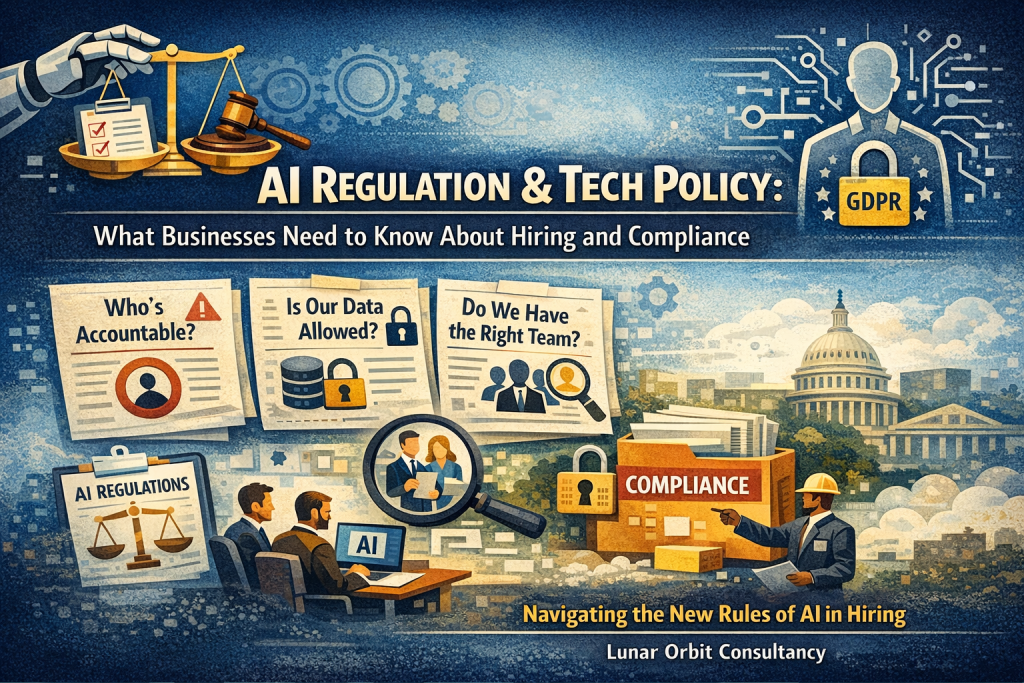
What started as a productivity boost quietly slipped into hiring decisions, customer interactions, credit approvals, marketing automation, and internal analytics. And suddenly, companies found themselves asking uncomfortable questions:
- Who is accountable if an AI system makes a bad decision?
- Are we even allowed to use this data?
- Do we have the right people to manage this responsibly?
That’s where AI regulation and tech policy enter the picture. Not as abstract government paperwork — but as a real business constraint that affects how you hire, who you hire, and how fast you can grow.
For staffing agencies and consultancies like Lunar Orbit Consultancy, this shift isn’t theoretical. It’s already reshaping workforce demand.
Why AI Regulation and Tech Policy Matter to Businesses (Even If You’re Not a Tech Company)
Many companies assume AI rules only affect Big Tech. That assumption is risky.
If your organization uses:
- automated screening tools
- predictive analytics
- chatbots or recommendation engines
- AI-powered HR, finance, or customer systems
you are already inside the regulatory conversation.
AI regulation and tech policy exist to answer three simple questions:
- Is the system safe?
- Is it fair?
- Is someone accountable?
And answering those questions requires more than lawyers. It requires people — trained, cross-functional people.
A Global Overview: How global AI regulations Are Taking Shape
There is no single global AI rulebook. That’s part of the problem.
Key regulatory approaches shaping hiring decisions:
- European Union: A risk-based system under the EU AI Act that places strict obligations on “high-risk” AI uses, especially in hiring, finance, healthcare, and public services.
- United States: A standards-driven approach using agency guidance and risk frameworks rather than one central law.
- China: Direct oversight of algorithms, platforms, and recommendation systems.
- India: A balanced model focused on innovation with safeguards, gradually tightening through data protection and sector-specific rules.
For multinational businesses, this means compliance complexity multiplies, and so does the need for policy-aware talent.
AI Regulation in India: What Indian Businesses Should Pay Attention To
AI regulation in India is evolving quietly but decisively.
Instead of aggressive bans, India is focusing on:
- data protection obligations
- responsible AI principles
- sector-based oversight (finance, healthcare, public platforms)
The result? Companies operating in India must now ensure:
- lawful data usage
- explainable automated decisions
- internal accountability mechanisms
This creates demand for professionals who understand both Indian regulatory expectations and operational realities— a rare but growing talent segment.
What Are AI Governance Frameworks (And Why HR Teams Care)
An AI governance framework is not a technical document. It’s an operating model.
In simple terms, it answers:
- Who owns an AI system?
- How is risk assessed?
- How are decisions explained?
- What happens when something goes wrong?
Common components of AI governance frameworks:
- Risk classification and documentation
- Data ownership and consent processes
- Human oversight roles
- Monitoring and audit mechanisms
Here’s the staffing implication:
You cannot implement governance without people who know how to run it.
That’s why roles like AI compliance leads, data governance managers, and model risk analysts are appearing across industries.
AI Compliance for Companies Is Now a Hiring Problem
For years, compliance lived inside legal teams.
Today, AI compliance for companies cuts across:
- product teams
- engineering
- HR
- procurement
- leadership
This has created a serious talent gap.
What companies are struggling to hire:
- Professionals who understand regulation and technology
- Leaders who can translate policy into workflows
- Teams capable of documenting, auditing, and monitoring AI systems
Traditional hiring pipelines are not designed for this. Staffing agencies that understand regulatory talent are.
The Impact of AI Regulation on Jobs and Skills
The impact of AI regulation on jobs is not about mass unemployment, it’s about job redesign.
What’s changing:
- Routine, low-context roles are declining
- Oversight, governance, and decision-review roles are increasing
- Hybrid skills are becoming more valuable than pure technical depth
Roles growing because of regulation:
- AI auditors
- Responsible AI specialists
- Data protection officers
- Policy-aware product managers
Regulation doesn’t kill jobs. It creates demand for better-defined ones.
Tech Policy and Workforce Planning: The Missing Link
Most workforce plans ignore regulation. That’s a mistake.
Tech policy and workforce planning must now move together.
Smart organizations are:
- Mapping AI usage across departments
- Identifying compliance-sensitive functions
- Hiring governance talent before regulators knock
- Using staffing partners to fill short-term gaps
This is especially critical for startups and mid-sized firms that don’t yet have internal policy teams.
Why Staffing Agencies Matter More in a Regulated AI World
Hiring for regulated environments is not about volume, it’s about precision.
Staffing consultancies like Lunar Orbit Consultancy add value by:
- Understanding regulatory context
- Screening for policy literacy
- Sourcing hybrid profiles faster than in-house teams
- Reducing compliance risk through better role matching
In a world shaped by AI regulation and tech policy, bad hiring decisions are not just expensive, they’re also risky.
How Businesses Should Prepare Right Now
If your organization uses AI in any form, start here:
- Audit your AI usage — tools, vendors, decision points
- Identify compliance-sensitive roles
- Decide what to build internally vs outsource
- Partner with staffing experts who understand regulation
- Upskill existing teams where possible
Preparation is cheaper than correction.
Frequently Asked Questions (FAQs)
1. What is meant by AI regulation and tech policy?
AI regulation and tech policy refer to laws, standards, and guidelines that govern how artificial intelligence systems are built, used, and monitored to ensure safety, fairness, and accountability.
2. Does AI regulation apply to non-tech companies?
Yes. Any business using AI-driven tools for hiring, finance, customer service, or analytics may fall under regulatory obligations.
3. How does AI regulation affect hiring decisions?
It increases demand for compliance-aware professionals, governance roles, and hybrid talent who understand both technology and policy.
4. What is AI governance in simple terms?
AI governance is the internal system that ensures AI tools are used responsibly, legally, and transparently within an organization.
5. Is AI regulation in India strict?
India currently follows a balanced approach, focusing on innovation with safeguards, but expectations around data protection and accountability are rising.
6. Why should companies work with staffing agencies on AI compliance?
Because regulatory hiring requires specialized screening, faster access to niche talent, and reduced risk, areas where expert staffing consultancies excel.
Final Thought
AI isn’t slowing down. Regulation isn’t going away.
The companies that succeed will be the ones that hire for responsibility, not just speed.
If you want your workforce to keep up with AI regulation and tech policy, Lunar Orbit Consultancy helps you find the people who already understand the rules, and know how to work within them.